



Nikkei Asia - ByteDance comes out on top in China's Lunar New Year battle for users
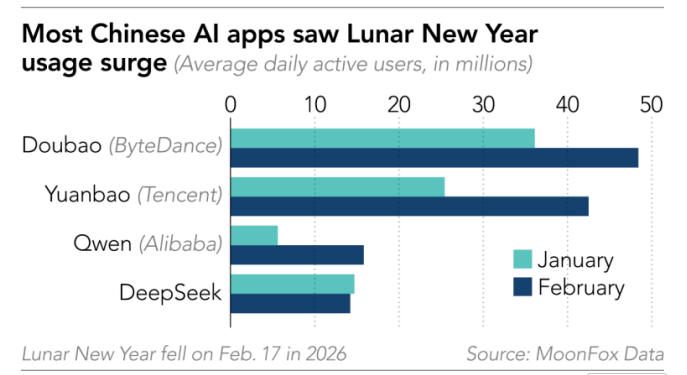
HONG KONG -- ByteDance's Doubao AI chatbot emerged as the biggest winner in the race to acquire new users over China's Lunar New Year holiday, followed by Tencent's Yuanbao, newly released data shows.
Chinese tech companies mounted a lavish push to popularize their AI offerings in the runup to the holiday, also known as the Spring Festival, collectively investing more than 8 billion yuan ($1.2 billion) for "red envelope" incentives as the battle for users intensifies.
According to Chinese data company MoonFox, Tencent's Yuanbao, ByteDance's Doubao, Alibaba's Qwen, and DeepSeek have captured more than 70% of China's chatbot market.
Among the four chatbots, Doubao continued to lead, thanks in part to ByteDance serving as the exclusive AI cloud partner for China Central Television's 2026 Spring Festival Gala, the biggest cultural event of the year watched by families across the country.
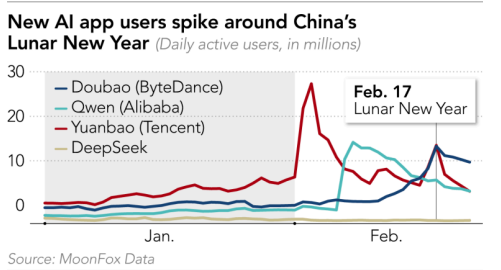
Yuanbao followed closely behind, experiencing a short-term surge before easing back later on, while Qwen overtook DeepSeek before experiencing a relatively modest decline in traffic afterward.
Baidu, which also joined the red envelope fight as it struggles with user acquisition, experienced a short-lived download boom for its Ernie chatbot, though its ranking quickly declined after the Spring Festival.
Daiwa analyst John Choi said that despite the brief boost in downloads, user retention will be the major metric to monitor. "While we think user mindshare is far from well developed, the strength of internet ecosystems and model performance is equally important to retain users subsequently," he said in a note.
Platforms were quick to tout their holiday-season achievements. Qwen said this week that during the Spring Festival, its app helped users place nearly 200 million orders with "just one sentence." Doubao said last week that on Feb. 16 --Lunar New Year's Eve -- total interactions on the chatbot reached 1.9 billion, and the app helped users generate more than 100 million New Year greetings that day. Tencent, meanwhile, said Yuanbao's daily active users surpassed 50 million and its monthly active users reached 114 million.
Chinese companies also released new models or major updates to their foundation models, during the Lunar New Year. These included Alibaba's Qwen 3.5, ByteDance's Seedance 2.0, Minimax 2.5, Moonshot's Kimi K2.5, and Zhipu AI's GLM-5, though DeepSeek did not release its rumored new model, V4.
Currently, Chinese AI companies are valued at less than 10% of their American counterparts, but Daiwa said in a research note this week that the trend for globalization of Chinese large language models "is still underappreciated," as their global market share is continuing to increase due to their cost efficiency.
According to OpenRouter's AI model rankings, which are based on actual data from millions of users accessing models through the platform, Chinese models, led by Kimi and Minimax, accounted for over 35% of the global market as of last week, compared to 10% over the same period in 2025.
The competition for global users is intensifying between U.S. and Chinese tech companies, particularly given that Chinese ones keep offering cheaper rates for model usage. Earlier this week, U.S. AI giant Anthropic joined OpenAI in flagging "industrial-scale distillation attacks" on its models by their Chinese counterparts, namely DeepSeek, Minimax, and Moonshot, to train and improve their own models.
DeepSeek, Minimax and Moonshot did not respond to a request for comment.
.png)
月狐数据双项入选信通院“铸基计划”,数据能力再获国家级权威认可
8月下旬丨AI大模型竞争格局、Q2汽车与移动互联网报告获多平台广泛引用
8月上旬丨媒体声量监测:智能PPT、AI应用与汽车行业研究多点开花
7月下旬丨月狐数据媒体引用汇总:新能源汽车·养老·教育·AI多赛道